Common Documentation Errors When replacing a commissioner
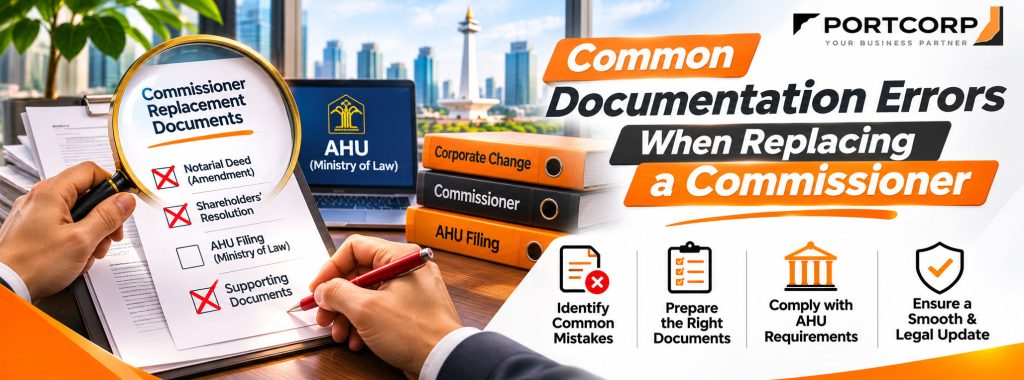
Replacing a commissioner in an Indonesian company may appear to be a straightforward corporate decision, particularly when shareholders have already agreed on the new appointment. However, the administrative process can become complicated when the supporting documents contain inconsistent information, incomplete resolutions, or outdated corporate records. These problems are especially relevant to foreign-owned companies, where shareholders and appointed commissioners may be located in different countries.
For a PT PMA operating in Indonesia, replacing a commissioner requires careful coordination between shareholders, company directors, notaries, and the relevant government administration system. Even when the appointment itself is commercially agreed upon, errors in the documentation can delay the recording of the change and create inconsistencies between the company’s internal records and official corporate information.
Understanding the most common documentation mistakes can help businesses prepare a more accurate and organized submission. This article examines the issues that frequently arise when replacing a commissioner in Indonesia, explains why they matter, and provides practical recommendations for avoiding unnecessary administrative complications.
Why Documentation Accuracy Matters When Replacing a Commissioner
The Board of Commissioners plays an important supervisory role in an Indonesian limited liability company. Commissioners oversee the company’s management and provide advice to the Board of Directors in accordance with Indonesian company law and the company’s articles of association. Their appointment and replacement must therefore be documented through the appropriate corporate procedures.
Under Article 111 of Law No. 40 of 2007 concerning Limited Liability Companies, the General Meeting of Shareholders, commonly referred to as RUPS, has authority over the appointment, replacement, and dismissal of commissioners. The law also establishes requirements concerning the effective date of the change and notification to the relevant ministry. These obligations make accurate corporate documentation essential.
Minister of Law Regulation No. 49 of 2025 further governs administrative procedures for company establishment, amendments, and changes to company data. For companies replacing commissioners, the applicable procedures involve notarial documentation and electronic submission through the Legal Entity Administration System, commonly known as SABH or AHU. Preparing the underlying records correctly can help avoid unnecessary corrections during this process.
1. Using an Outdated Shareholder Resolution
One common documentation problem occurs when companies rely on an old shareholder resolution or reuse a document prepared for a previous corporate change. Although templates can simplify administrative work, they may contain outdated shareholder information, incorrect company details, or references to individuals who no longer hold the relevant positions. These inconsistencies can create uncertainty about whether the resolution accurately represents the company’s current corporate structure.
For example, a PT PMA may have experienced a shareholder transfer before deciding to replace its commissioner. If the new resolution still identifies the previous shareholders, the document may not accurately reflect the parties entitled to participate in the decision. This can lead to questions about the validity of the approval and the supporting corporate records.
Before preparing a resolution, the company should verify its latest shareholder register, articles of association, and relevant AHU records. The resolution should be drafted specifically for the proposed commissioner replacement rather than copied without review from an earlier transaction. This simple verification can prevent several documentation problems from developing later.
2. Incorrect Personal Information for the Incoming Commissioner
Errors in the incoming commissioner’s personal information are another common source of administrative difficulty. Names, identification numbers, dates of birth, nationalities, and other relevant personal details should be consistent across the supporting documents. Even minor differences can require clarification when the notary or reviewing institution compares the information.
For foreign commissioners, the company may need to rely on passport details and other supporting identification documents. Problems can arise when an individual’s name is written differently across documents or when an expired passport is used as the primary reference. Variations in name order, abbreviations, or transliteration can also create inconsistencies.
The company should obtain clear identification documents before finalizing the appointment paperwork. Personal information should be checked against the original supporting records and used consistently throughout the corporate documentation. Where an identification document has changed, the notary should be informed so that the appropriate information can be recorded.
3. Failing to Confirm the Existing Commissioner’s Legal Status
A company should establish the legal status of the outgoing commissioner before preparing replacement documents. The relevant circumstances may involve resignation, dismissal, expiration of an appointment term, or another event requiring corporate action. These situations should not automatically be treated as identical because the applicable documentation and procedures may differ.
For example, a commissioner whose appointment period has expired may require a different supporting explanation from a commissioner who is being dismissed before the end of the term. The company’s articles of association may also contain specific provisions governing appointments, replacements, and dismissals. Failing to review these provisions can result in a resolution that does not properly reflect the legal circumstances.
Management should therefore examine the previous appointment documents, applicable term of office, and relevant corporate records. The proposed replacement should be documented in a manner consistent with the company’s actual situation. This helps establish a clear record of why the position is changing and when the new appointment takes effect.
4. Missing or Unclear Effective Dates
An effective date is an important element of commissioner replacement documentation. Under Article 111 of the Indonesian Company Law, shareholder decisions concerning commissioner appointments, replacements, and dismissals address when those changes become effective. Where the shareholders do not specify an effective date, the statutory default generally links effectiveness to the closing of the shareholders’ meeting.
Problems can arise when the shareholder resolution, notarial documentation, and internal company records refer to different dates. Such inconsistencies may create uncertainty about who held the supervisory position during a particular period. They may also complicate the calculation of applicable administrative notification deadlines.
Companies should confirm the intended effective date before the resolution is signed. The date should be reflected consistently in the relevant documents, and the notary should be informed of any special timing arrangements. Clear documentation helps establish an accurate corporate history and reduces the likelihood of conflicting records.
5. Incomplete Shareholder Meeting Documentation
The General Meeting of Shareholders is central to the commissioner appointment process. Depending on the company’s articles of association and the applicable legal provisions, the meeting documentation may need to demonstrate that the relevant procedural requirements were satisfied. These may include appropriate notice, participation, quorum, voting, and recording of the decision.
A common mistake is preparing a short resolution without adequately documenting the authority of the participating shareholders or the basis on which the decision was approved. For companies with several foreign shareholders, the problem can become more complicated when participants are located overseas. Incomplete meeting records may require additional clarification before the notarial process can proceed.
Companies should coordinate the proposed meeting procedure with their notary or legal adviser before collecting signatures. Where a valid written shareholder decision outside a physical meeting is available under the applicable rules, the company should ensure that the relevant requirements are satisfied. Proper preparation is more efficient than attempting to reconstruct the decision-making process after the documents have been signed.
6. Using Incorrect or Incomplete Signatures
Signature-related problems can delay commissioner replacement documentation, particularly when shareholders or authorized representatives are based outside Indonesia. A document may be signed by an individual who lacks the necessary authority, or the signature page may not clearly identify the person signing. In other cases, the company may receive incomplete documents or versions that differ from the final approved resolution.
Foreign corporate shareholders may also appoint representatives to participate in the decision-making process. The company should verify whether those representatives have appropriate authority and whether supporting documents are required. Depending on the document and its intended use, notarization, legalization, or apostille requirements may need to be considered.
Before circulating the final documents, the company should establish who must sign and in what capacity. The signing instructions should identify the correct version, required supporting records, and acceptable execution method. This reduces the risk of having to repeat the signature process after the documents are returned.
7. Overlooking Commissioner Eligibility Requirements
Replacing a commissioner is not simply a matter of selecting a preferred individual. Indonesian company law establishes eligibility requirements for members of the Board of Commissioners, and additional conditions may apply to particular regulated industries. The company should therefore confirm that the proposed appointee satisfies the applicable requirements before completing the appointment.
Article 110 of Law No. 40 of 2007 addresses qualifications and restrictions relevant to commissioner appointments. The law also provides for supporting statements concerning eligibility, while competent authorities may establish additional requirements for certain sectors. These considerations can be particularly important for businesses operating in regulated industries.
A company should not assume that a candidate is automatically eligible because they are a shareholder, investor representative, or experienced executive. The necessary declarations and supporting documents should be reviewed before the appointment is finalized. This helps reduce the risk of recording a corporate decision involving an ineligible appointee.
8. Inconsistencies Between the Notarial Deed and Corporate Records
A commissioner replacement commonly involves preparing notarial documentation that records or declares the relevant shareholder decision. Errors can occur when the deed contains information that does not match the company’s latest corporate records. These inconsistencies may involve the company’s name, shareholder structure, commissioner details, or previous amendments.
For example, a company may have recently changed its registered address or shareholder composition. If the notarial documentation relies on an outdated corporate profile, the resulting records may contain conflicting information. The discrepancy may then need to be investigated before the administrative change can be completed.
The company should provide its notary with the latest establishment deed, relevant amendments, and available AHU records. Management should also review the draft documentation before execution, particularly where several corporate changes have occurred close together. A coordinated review helps ensure that the commissioner replacement is recorded against the correct corporate information.
9. Missing the Required Notification Deadline
A properly approved commissioner replacement must also be reflected in the relevant government records. Under Article 111 of the Company Law, the Board of Directors is responsible for notifying the minister of commissioner changes within the applicable 30-day period. Minister of Law Regulation No. 49 of 2025 also governs notification of changes to directors and commissioners through the relevant administrative system.
One common mistake is assuming that signing a shareholder resolution or completing a notarial deed automatically finishes the administrative process. The company may overlook the separate requirement to notify the change through the appropriate system. This can create problems when subsequent corporate changes are submitted or when third parties review the company’s official records.
The company should establish a timeline covering the shareholder decision, preparation of notarial documentation, and government notification. Management should also confirm that the relevant submission has been completed and that the resulting corporate records reflect the intended change. Tracking these steps can reduce the risk of an incomplete administrative process.
10. Forgetting to Review Beneficial Ownership Information
Commissioner replacements do not necessarily change a company’s beneficial ownership structure. However, a management change provides a useful opportunity to review whether the company’s beneficial ownership records remain accurate. Problems may arise when the company assumes that previously submitted information is still correct without checking whether other ownership or control arrangements have changed.
Indonesia’s corporate administration framework includes beneficial ownership reporting and verification requirements. Minister of Law Regulation No. 49 of 2025 also introduced additional documentation and verification procedures relevant to company administration. Depending on the circumstances, supporting beneficial ownership information may be relevant to the company’s corporate records and administrative submissions.
Before finalizing the commissioner replacement, the company should review whether any related changes affect its ownership or control information. Where no beneficial ownership change has occurred, the records should still remain consistent with the actual corporate structure. This review can help prevent unrelated discrepancies from complicating future administration.
11. Failing to Update Banks and Other Corporate Records
Completing the commissioner replacement through the appropriate corporate administration system does not necessarily update every external record maintained by the company. Banks, commercial counterparties, and other institutions may retain information based on earlier corporate documents. If these records are not reviewed, the company may continue using outdated commissioner details in certain administrative processes.
The need for an update depends on the institution and the role the commissioner plays in the relevant relationship. Some banks may request current corporate documentation as part of periodic due diligence, while certain commercial arrangements may require notification of changes in corporate governance. Not every commissioner replacement will trigger identical obligations.
After the official change has been recorded, management should identify which internal and external records require attention. These may include corporate registers, banking documentation, compliance files, and relevant contractual records. Maintaining consistency helps reduce confusion when the company undertakes future transactions.
12. Poor Coordination Between Foreign Shareholders and Local Administrators
Foreign-owned companies often experience documentation problems because the individuals responsible for approving corporate changes are located in different countries. Shareholders may operate in different time zones, while the Indonesian notary and administrative team work according to local procedures. Without clear coordination, document preparation can become fragmented.
For example, an overseas shareholder may sign an earlier draft while another shareholder signs a revised version. The company may then discover that the documents contain different effective dates or commissioner details. Correcting the inconsistency can require additional communication, new signatures, and revised supporting records.
A practical solution is to appoint a single coordinator responsible for managing the documentation process. This person should maintain the approved document versions, confirm signature requirements, and communicate with the notary. Clear responsibilities help reduce errors and make the replacement process easier to monitor.
Documentation Checklist Before Replacing a Commissioner
Before completing a commissioner replacement, the company should review the available documents against its current corporate records. The following checklist can help management identify common administrative gaps before the notarial and notification stages. The precise documentation required should still be confirmed with the appointed notary based on the company’s circumstances.
| Document or Requirement | What to Verify |
|---|---|
| Latest corporate deed | Company details and previous amendments are accurate |
| Shareholder information | Current shareholders and voting rights are correctly identified |
| Shareholder resolution | Decision is properly approved and documented |
| Effective date | Appointment and replacement dates are consistent |
| Outgoing commissioner records | Existing appointment and departure circumstances are clear |
| Incoming commissioner identification | Personal information matches supporting documents |
| Eligibility declarations | Applicable legal requirements are satisfied |
| Signatures and authority | Documents are executed by authorized parties |
| Notarial documentation | Information is consistent with the approved resolution |
| AHU notification | Submission is completed within the applicable timeframe |
| Beneficial ownership information | Records are reviewed for accuracy |
| External corporate records | Relevant banks and internal registers are updated where necessary |
A checklist is most useful when it is completed before the shareholder resolution is executed. Once documents have been signed, correcting inaccurate information can require additional formalities. Early verification therefore helps reduce administrative delays and unnecessary costs.
Practical Example: Commissioner Replacement in a Foreign-Owned Consulting PT PMA
Consider a Singapore-owned management consulting PT PMA operating in Jakarta. The company has two corporate shareholders, and its existing commissioner is being replaced by another executive from the overseas parent company. The shareholders have agreed on the appointment and want the change recorded before an upcoming corporate banking review.
During document preparation, the local administration team discovers that the proposed resolution uses the previous shareholder representative’s name. The incoming commissioner’s passport details are also inconsistent with the identification information supplied to the notary. Although the shareholders have already approved the replacement in principle, these discrepancies need to be corrected before the documentation can be finalized.
The company reviews its current shareholder records, confirms the authorized representatives, and obtains updated identification details. It then coordinates the corrected resolution and supporting documents with the notary. By resolving these issues before submission, the company can reduce the risk of further administrative complications.
This example demonstrates why documentation accuracy matters even when the underlying corporate decision is straightforward. The shareholders may agree on the appointment, but the supporting records must still accurately reflect the decision and the company’s current legal information. A structured document review can help bridge the gap between commercial approval and formal corporate administration.
How Portcorp Supports PT PMA Corporate Documentation
Foreign investors establishing or operating companies in Indonesia must manage a range of corporate documentation requirements. These responsibilities begin during incorporation and continue when shareholders appoint new directors or commissioners, change ownership arrangements, or amend company information. Inconsistent records can create administrative difficulties when several changes occur over time.
Portcorp provides business establishment and corporate administration support for companies entering and operating in the Indonesian market. Businesses exploring pt pma registration indonesia services can learn more about the incorporation considerations that establish the foundation for ongoing corporate governance. Maintaining accurate company information after incorporation is an important part of protecting that foundation.
For companies preparing to replace a commissioner, Portcorp can discuss the relevant corporate administration considerations and available support arrangements. Depending on the company’s circumstances and the agreed scope of services, this may include coordinating documentation requirements, reviewing administrative information, and identifying matters that should be addressed with the appointed notary or legal adviser. The objective is to help management approach corporate changes with clearer documentation and better coordination.
Frequently Asked Questions
What documents are needed to replace a commissioner in Indonesia?
The required documents depend on the company’s circumstances and applicable procedures. They commonly involve relevant corporate records, an appropriately approved shareholder decision, identification information for the incoming commissioner, and supporting notarial documentation. The company should confirm the specific requirements with its notary before preparing the final submission.
Can incorrect passport details delay a commissioner replacement?
Yes, inconsistent personal information can create problems during document preparation or verification. The company should ensure that the incoming commissioner’s details match the supporting identification documents. Any discrepancies should be resolved before the relevant corporate documents are finalized.
Does replacing a commissioner require a shareholder decision?
Generally, commissioner appointments and replacements fall within the authority of the General Meeting of Shareholders under Indonesian company law. The company’s articles of association and applicable legal procedures must also be considered. An appropriately documented shareholder decision provides the basis for the subsequent administrative steps.
How long does a company have to notify a commissioner change?
Article 111 of Law No. 40 of 2007 establishes a 30-day notification requirement following the relevant shareholder decision. The applicable administrative procedures should also be reviewed under Minister of Law Regulation No. 49 of 2025. Companies should coordinate the timing with their notary rather than waiting until the end of the period.
Does replacing a commissioner automatically change beneficial ownership?
No, a commissioner replacement does not necessarily change the company’s beneficial ownership. However, the company should review whether the appointment is accompanied by changes in ownership or control that affect its reporting information. Accurate records remain important for ongoing corporate administration.
Accurate Documentation Helps Prevent Commissioner Replacement Delays
Replacing a commissioner in an Indonesian company requires more than obtaining shareholder approval. The supporting documentation must accurately identify the parties involved, reflect the correct corporate decision, and remain consistent with the company’s current records. Errors involving personal information, signatures, effective dates, and outdated documents can complicate an otherwise straightforward process.
For PT PMA companies, the challenges may be greater when foreign shareholders and Indonesian administrators must coordinate across jurisdictions. A clear document checklist, reliable communication, and early involvement of the appointed notary can help reduce these risks. Management should also ensure that the necessary government notification and subsequent record updates are completed.
The most practical approach is to review the documentation before the shareholder decision is formally executed. Identifying discrepancies early can reduce the need for corrections and help maintain reliable corporate records. This preparation supports better governance and smoother administration as the company continues operating in Indonesia.
Has Your Company Approved a New Commissioner but Not Checked the Paperwork?
Your shareholders may already know who will replace the current commissioner, yet the documents supporting that decision may still need attention. An outdated shareholder record, inconsistent passport information, or unclear effective date can create additional work when the company is preparing its notarial documentation. These issues are often easier to address before the final documents are signed.
If your PT PMA is preparing a commissioner replacement, Portcorp can help you discuss the relevant corporate administration considerations and identify which documentation questions should be clarified. You can begin by explaining whether the change involves a resignation, dismissal, or replacement at the end of an appointment term. Providing the intended effective date and a brief description of the company’s shareholder structure can also help make the initial discussion more productive.
Free initial consultation through WhatsApp
Before circulating the final shareholder resolution, consider reviewing the documentation requirements with Portcorp. The team can discuss the available support arrangements and help you identify the appropriate next steps for your Indonesian company. Contact Portcorp for a free initial consultation through WhatsApp +62 816-1339-900.
