Pre-Shipment Compliance Checklist for industrial machinery Entering Indonesia
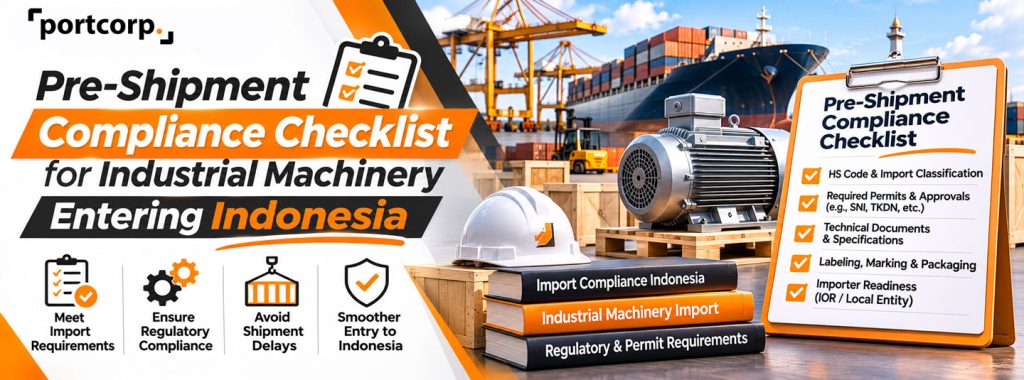
Importing industrial machinery into Indonesia requires more than arranging international transportation and preparing a commercial invoice. Foreign manufacturers, equipment suppliers, and Indonesian buyers must ensure that the machinery satisfies applicable import regulations before the shipment leaves its country of origin. Failure to complete these checks can result in customs delays, unexpected expenses, or complications that disrupt production schedules.
For companies importing CNC machines, industrial pumps, production lines, packaging equipment, compressors, or automation systems, pre-shipment compliance is particularly important because industrial machinery often involves substantial investment. A delayed machine can affect factory installation schedules, contractor availability, and planned production capacity. Even when the equipment itself is technically suitable, incomplete documentation or incorrect import arrangements can create significant operational problems.
Indonesia’s import regulations establish requirements concerning importer registration, product classification, import licensing, customs declarations, and certain restricted goods. These requirements can differ depending on the machinery’s specifications, condition, country of origin, and intended use. This guide provides a practical pre-shipment compliance checklist to help overseas suppliers and Indonesian businesses identify potential problems before dispatching industrial equipment.
Why Pre-Shipment Compliance Matters for Industrial Machinery
Industrial machinery shipments frequently involve equipment that is expensive, technically complex, and difficult to replace at short notice. Unlike ordinary consumer products, machinery may require specialized transportation, professional installation, and coordination with factory engineering teams. Any interruption during customs clearance can therefore have consequences beyond additional storage or logistics costs.
Pre-shipment compliance helps companies identify regulatory requirements while there is still time to address them. Importers can verify the machinery’s classification, confirm applicable permits, and review supporting documents before the cargo reaches Indonesia. Exporters can also ensure that technical descriptions, serial numbers, and shipment details are consistent across the relevant paperwork.
The objective is not simply to accelerate customs clearance. A structured review also helps companies understand the financial, legal, and operational responsibilities associated with the transaction. By resolving uncertainties before shipping, businesses can reduce avoidable risks and establish more reliable delivery schedules.
1. Confirm the Machinery’s Correct HS Code
The first step in preparing an industrial machinery shipment is identifying the appropriate Harmonized System (HS) classification. HS codes are used to classify internationally traded goods and help determine applicable customs duties, import restrictions, and regulatory requirements. Indonesia applies its national tariff classification framework when assessing imported products.
Industrial machinery can be difficult to classify because equipment with similar commercial descriptions may perform different functions. For example, a machine used for cutting metal may have a different classification from equipment designed for forming, drilling, or processing other materials. A complete production line may also contain several components that require careful classification analysis.
Before confirming the HS code, the supplier should provide detailed technical information, including the machinery’s primary function, model number, specifications, and relevant product documentation. Importers should avoid relying exclusively on the HS code previously used in another country because classification rules and national tariff subdivisions may differ. Where uncertainty remains, professional classification advice or an appropriate customs determination procedure should be considered.
2. Verify That the Indonesian Importer Is Eligible
A foreign manufacturer cannot assume that any Indonesian company can legally import industrial machinery. The importer must satisfy the registration and authorization requirements applicable to the transaction. Under Indonesia’s import framework, the Business Identification Number, or NIB, functions as an Importer Identification Number (API) for qualifying import activities.
The applicable importer arrangement may depend on whether the machinery is intended for resale, use in the importer’s own production activities, or another permitted purpose. Additional approvals may also apply depending on the equipment’s classification and regulatory status. Therefore, identifying the importer is a compliance decision rather than merely an administrative detail on the shipping documents.
Foreign suppliers without an Indonesian subsidiary may consider an eligible local importing arrangement. Businesses evaluating importer of record indonesia services should confirm whether the proposed importing entity is authorized to handle the specific machinery and transaction. This verification should take place before the exporter commits to a shipment date.
3. Check Import Restrictions and Required Permits
Not all industrial machinery is subject to identical import requirements. Certain products may require specific approvals, technical documentation, or compliance with restrictions established by Indonesian authorities. The applicable requirements depend on the machinery’s HS classification and other relevant characteristics.
Indonesia’s general import policy framework includes Minister of Trade Regulation No. 16 of 2025, as subsequently amended, including by Regulation No. 18 of 2026. Other regulations address particular product categories and restricted goods. Because import requirements can change, exporters and importers should verify the rules applicable to the actual shipment rather than relying on an outdated checklist.
Where an import approval or other authorization is required, the parties should establish whether it must be obtained before shipment. They should also confirm the validity period, authorized quantities, and any conditions attached to the approval. Dispatching machinery before resolving these questions can create complications that may not be easily corrected after arrival.
4. Determine Whether the Machinery Is New or Used
The condition of industrial machinery is a critical consideration because Indonesia regulates imports of certain non-new goods. Equipment described as refurbished, reconditioned, second-hand, or previously operated may be subject to requirements different from those applicable to new machinery. The commercial description used by the seller does not automatically determine its regulatory status.
Minister of Trade Regulation No. 24 of 2025 establishes a framework for imports of certain non-new goods, including qualifying capital goods. Depending on the machinery and intended purpose, import eligibility may be subject to specific conditions and approvals. Companies should not assume that all used production equipment can be imported simply because it remains operational.
Before purchasing or shipping used machinery, the buyer should provide the equipment’s manufacturing year, operating history, condition, and intended use. The parties should then confirm whether the relevant equipment category is eligible for import and whether any additional documentation or verification is required. These checks are particularly important for second-hand production lines and refurbished industrial equipment.
5. Prepare Complete Technical Specifications
Technical documentation plays an important role in machinery classification, import eligibility, and customs verification. Customs authorities may need sufficient information to understand what the equipment does and whether its declared classification is appropriate. Generic descriptions such as industrial machine or factory equipment may not provide enough detail.
A useful technical documentation package should identify the manufacturer, model, serial number, principal function, operating capacity, and relevant technical characteristics. Depending on the equipment, supporting materials may include catalogs, product photographs, engineering drawings, or operating manuals. The information should accurately describe the goods being shipped.
Consistency is particularly important when a machine consists of several modules or accessories. The commercial invoice, packing list, and technical documentation should describe the shipment in a way that allows the relevant components to be identified. Discrepancies between these documents can lead to additional questions during customs processing.
6. Review the Commercial Invoice Before Dispatch
The commercial invoice is a fundamental document for an international machinery transaction. It identifies the seller, buyer, goods, transaction value, and other commercial information relevant to the shipment. Indonesian customs authorities may use the invoice as part of their assessment of the import declaration and supporting documentation.
Before dispatch, the exporter should verify that the invoice accurately identifies the machinery and reflects the agreed transaction terms. The description should be sufficiently detailed to distinguish the equipment from other products, while the currency, quantities, and values should be consistent with the underlying sales agreement. Any separate charges or relevant transaction adjustments should also be documented appropriately.
Companies should avoid deliberately understating invoice values or using misleading descriptions to reduce import costs. Customs valuation follows applicable legal rules, and the declared value may require adjustments depending on the transaction. A transparent invoice and supporting commercial records help establish a more reliable basis for customs assessment.
7. Ensure the Packing List Matches the Physical Shipment
Industrial machinery often requires specialized packing arrangements because of its weight, dimensions, and sensitivity to movement or environmental conditions. Large machines may be dismantled into several sections for transportation, while accessories and spare parts may be packed separately. These arrangements should be reflected accurately in the packing list.
The packing list should identify the number of packages, contents, gross and net weights, dimensions, and relevant package references. Where appropriate, serial numbers and component descriptions should be included to help connect the documentation with the actual equipment. This is especially useful when several containers carry different parts of the same production line.
The exporter should verify the packing list against the final packed cargo rather than relying solely on preliminary information. Changes made during loading should be reflected in the documentation before the shipment is dispatched. Accurate packing information also helps freight forwarders plan handling equipment and delivery arrangements.
8. Confirm Shipping Terms and Responsibility for Import Costs
The agreed Incoterms rule affects how transportation responsibilities, costs, and risks are allocated between the seller and buyer. Industrial machinery contracts may involve arrangements such as FOB, CIF, FCA, or DAP, depending on the shipment and commercial negotiations. However, Incoterms do not replace Indonesian import regulations or automatically establish who is legally eligible to act as importer.
Before shipping, both parties should understand who arranges international freight, purchases insurance, handles customs clearance, and pays import-related charges. The agreement should also address responsibility for delays, damaged equipment, and delivery coordination. These matters are particularly important for high-value machinery that requires special transportation or unloading arrangements.
Foreign suppliers should be cautious when agreeing to deliver equipment on terms that appear to make them responsible for Indonesian import clearance. Without an appropriate importing structure, the supplier may be unable to fulfill certain obligations as originally expected. Reviewing the commercial terms alongside importer eligibility can prevent disputes after the cargo has departed.
9. Calculate Estimated Duties, Taxes, and Landed Costs
A machinery purchase price does not represent the full cost of bringing equipment into Indonesia. Importers should evaluate applicable customs duties, import taxes, freight, insurance, port handling, customs services, and inland transportation. Additional expenses may arise when machinery requires specialized unloading or delivery equipment.
The applicable customs duty rate depends on the product classification and any relevant preferential tariff treatment. Import-related taxes may include VAT and income tax collected on imports, subject to the applicable rules and exemptions. Businesses should not apply a single assumed tax percentage to every machinery shipment without verifying the relevant classification and circumstances.
A landed-cost estimate should be prepared before the shipment is confirmed. This allows the buyer to assess the total investment and determine whether sufficient funds are available for clearance and delivery. For factory expansion projects, accurate cost planning can also help prevent unexpected changes to the capital expenditure budget.
10. Check Certificates of Origin and Preferential Tariff Eligibility
Certain machinery shipments may qualify for preferential customs duty treatment under applicable trade agreements. Eligibility generally depends on the product’s origin, the relevant agreement, and compliance with its rules of origin and documentation requirements. The country from which machinery is shipped is not necessarily the same as its qualifying country of origin.
If preferential treatment is being considered, the importer should confirm the applicable tariff arrangement and documentary requirements before shipment. Depending on the agreement, a certificate of origin or another prescribed origin document may be necessary. The information should be consistent with the commercial invoice and shipment details.
A certificate of origin does not automatically guarantee preferential treatment. Customs authorities may examine whether the goods satisfy the relevant origin rules and procedural conditions. Importers should therefore confirm eligibility rather than assuming that a document alone will reduce the duty payable.
11. Coordinate Freight, Packaging, and Delivery Readiness
Machinery shipments may require special handling because of oversized dimensions, concentrated weight, or sensitive components. Freight planning should account for the equipment’s actual measurements, lifting requirements, and packaging configuration. These details can affect container selection, port handling, and transportation from the port to the final installation site.
For large production equipment, the importer should confirm whether the receiving factory can accommodate the shipment. Access roads, unloading facilities, cranes, and installation schedules may all influence delivery planning. Customs clearance should therefore be coordinated with the operational team responsible for receiving the machinery.
The exporter should also consider packaging requirements relevant to the materials used, including applicable rules for wood packaging where necessary. Appropriate protection against moisture, corrosion, and transportation damage is important for industrial equipment. A compliant import shipment can still experience costly operational problems if the machinery arrives damaged or cannot be unloaded safely.
12. Review Customs Documentation Before the Vessel Departs
Indonesia’s customs procedures require import declarations supported by relevant documentation. For imports for domestic use, the Pemberitahuan Impor Barang (PIB) is a principal customs declaration, supported by documents such as commercial invoices, packing lists, transport documents, and applicable import authorizations. The exact requirements depend on the goods and the circumstances of the import.
Before dispatch, the exporter, importer, and logistics representatives should compare the available documentation. The machinery description, quantity, weight, value, and relevant party information should be consistent across the documents. Any missing information should be identified early enough for correction.
Customs clearance may involve documentary review or physical inspection based on applicable risk management procedures. If an inspection is required, accurate documentation can help the importer explain the shipment and identify the goods. Preparing these materials before departure is generally more efficient than attempting to reconstruct the shipment details after arrival.
Industrial Machinery Pre-Shipment Compliance Checklist
The following checklist summarizes the principal matters that should be reviewed before industrial machinery is dispatched to Indonesia. It can be used as an internal coordination tool between the exporter, Indonesian buyer, importing entity, and freight forwarder. Each item should be confirmed against the actual equipment and applicable regulations rather than treated as an automatic approval.
| Compliance Item | Pre-Shipment Verification |
|---|---|
| HS classification | Confirm the appropriate Indonesian tariff classification |
| Importer eligibility | Verify NIB/API status and relevant importer authorization |
| Import permits | Identify and obtain applicable approvals before shipment |
| Machinery condition | Confirm whether the equipment is new or non-new |
| Technical documentation | Prepare specifications, model details, and identification records |
| Commercial invoice | Verify descriptions, quantities, values, and transaction terms |
| Packing list | Match package details with the final physical shipment |
| Incoterms | Clarify transport, insurance, clearance, and payment responsibilities |
| Duties and taxes | Prepare an estimated landed-cost calculation |
| Country of origin | Review applicable origin documentation and tariff preferences |
| Freight arrangements | Confirm packaging, handling, and delivery requirements |
| Customs documents | Check consistency before cargo departure |
A shipment should not proceed merely because most items have been completed. Certain unresolved matters, such as importer eligibility or mandatory import approvals, may be significant enough to require postponement. The responsible parties should document outstanding issues and confirm that critical requirements have been satisfied before authorizing dispatch.
Practical Example: Importing an Automated Packaging Machine into Indonesia
Consider a German manufacturer supplying an automated packaging machine to an Indonesian food processing company. The equipment is newly manufactured and will be installed as part of a factory expansion project. The Indonesian buyer expects the machine to arrive within a defined period so that installation engineers can begin commissioning.
Before shipment, the supplier provides detailed technical specifications, the machine’s model information, and a draft commercial invoice. The Indonesian importer reviews the proposed HS classification and checks whether any product-specific restrictions or approvals apply. The parties also confirm the applicable shipping terms and prepare an estimate of duties, taxes, and logistics costs.
During the document review, the importer discovers that the preliminary packing list does not include the weight of a separately packed control cabinet. The exporter corrects the document before loading, allowing the freight arrangements and customs paperwork to reflect the complete shipment. Although the correction appears minor, identifying it early helps reduce uncertainty during transportation and clearance.
This example illustrates how pre-shipment compliance combines regulatory verification with practical coordination. The goal is to ensure that the equipment, documentation, importing arrangements, and delivery plans are aligned before the cargo leaves the exporting country.
How Portcorp Supports Industrial Machinery Import Preparation
Foreign machinery suppliers may understand their products in considerable technical detail but still find Indonesian import requirements difficult to navigate. The challenges can become greater when the supplier does not have an Indonesian subsidiary or when the local buyer lacks experience importing specialized equipment. In these circumstances, early coordination with an import services provider can help identify the administrative requirements associated with the proposed shipment.
Portcorp provides import-related business support for overseas companies entering the Indonesian market. For industrial machinery transactions, the Portcorp team can discuss the proposed equipment, importing arrangements, and documentation considerations before the shipment is scheduled. Depending on the machinery and agreed service scope, relevant support may involve reviewing import eligibility, identifying documentation requirements, and coordinating appropriate import-related services.
For overseas manufacturers, this preparation can be valuable when delivery deadlines are linked to factory expansion or equipment installation projects. A structured review helps identify which information must be obtained from the supplier and which requirements need confirmation in Indonesia. Any importing arrangement remains subject to the applicable laws, product restrictions, and eligibility of the responsible importer.
Frequently Asked Questions
What documents are generally needed to import industrial machinery into Indonesia?
Typical supporting documents include a commercial invoice, packing list, transport document, and relevant technical information. The importer may also need product-specific permits, origin documents, or other supporting records depending on the machinery and transaction. Requirements should be confirmed before shipment because not every machine is subject to the same rules.
Can a foreign company ship industrial machinery without an Indonesian subsidiary?
A foreign supplier may be able to sell machinery to an Indonesian customer without establishing its own subsidiary, provided the import is handled through an eligible importing arrangement. The appropriate structure depends on the equipment, the importer, and the commercial transaction. Import eligibility should be confirmed before the shipment is dispatched.
Are used industrial machines allowed to enter Indonesia?
Certain non-new capital goods may be eligible for import under applicable regulations, but restrictions and approval requirements can apply. Eligibility depends on factors such as the machinery category, importer status, and intended use. Suppliers should not dispatch used equipment before confirming the relevant requirements.
Why is the HS code important for machinery imports?
The HS classification helps determine the applicable customs tariff and whether the machinery is subject to specific import restrictions. An incorrect classification can lead to inaccurate duty calculations or licensing assessments. Technical specifications should be reviewed carefully before selecting the code.
Should import permits be obtained before shipment?
Where a regulation requires an approval before importation or shipment, the relevant requirement should be satisfied within the prescribed timeframe. Importers should verify the applicable conditions for their particular machinery. Assuming that all permits can be arranged after arrival can create unnecessary regulatory and commercial risks.
Complete the Compliance Review Before Shipping
Successful industrial machinery imports depend on preparation that begins well before the cargo reaches Indonesia. Foreign suppliers and Indonesian buyers should verify the machinery’s classification, importer eligibility, applicable permits, condition, supporting documentation, and estimated import costs. These checks help reduce uncertainty and support more reliable delivery planning.
For high-value production equipment, compliance problems can affect far more than customs clearance. Delays may disrupt factory expansion schedules, installation arrangements, and the availability of specialist engineers. A structured pre-shipment review therefore supports both regulatory compliance and operational readiness.
Companies should treat the checklist as a practical starting point rather than a substitute for shipment-specific verification. Import regulations and product requirements must be assessed against the actual equipment and the rules in force at the time of importation. Completing this work before dispatch gives businesses a stronger foundation for managing their machinery shipments.
Your Machinery Is Ready for Export. Is the Indonesian Import Documentation Ready Too?
A production machine may have passed its final factory inspection and be ready for collection, but that does not necessarily mean the shipment is ready to enter Indonesia. Before confirming vessel space or releasing the equipment to a freight forwarder, it is worth checking whether the importer, HS classification, required approvals, and supporting documents have been properly reviewed. Identifying a compliance issue while the machine is still at the supplier’s facility is often easier than addressing it after the cargo reaches an Indonesian port.
Portcorp can help you begin that review by discussing the relevant import requirements and available support arrangements for your proposed machinery shipment. To make the initial discussion useful, prepare the machine’s description, model, country of origin, condition, estimated shipment value, and intended Indonesian destination. These details can help identify which compliance questions should be resolved before you authorize dispatch.
Before you release your machinery for shipment, give your import plan a compliance check
Contact Portcorp for a free initial consultation through WhatsApp +62 816-1339-900 and discuss the documentation and importing arrangements relevant to your equipment.
