Importer of Record vs Local Distributor for industrial machinery, Choosing the Right Model
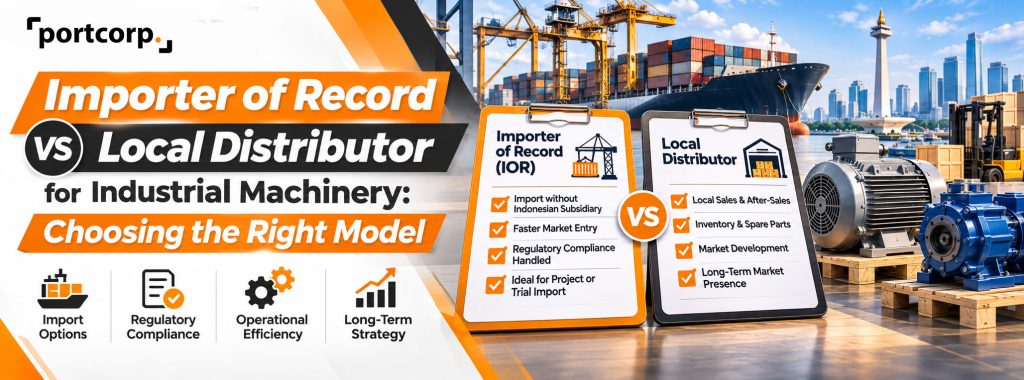
Indonesia presents significant opportunities for international manufacturers of industrial machinery, automation equipment, production systems, and engineering components. As Indonesian factories invest in productivity, modernization, and industrial expansion, overseas suppliers must determine how to deliver their equipment efficiently and compliantly.
One of the most important decisions is whether to use an Importer of Record (IOR) or appoint a local distributor.
Both arrangements can support industrial machinery sales in Indonesia, but they serve different commercial purposes.
An Importer of Record primarily addresses the legal and administrative responsibilities associated with importing goods. A local distributor typically purchases, markets, resells, and sometimes services equipment within an agreed territory.
Choosing the wrong arrangement can affect profit margins, customer relationships, customs compliance, technical support, and long-term market development.
This guide compares Importer of Record and local distributor arrangements for industrial machinery, helping foreign manufacturers select a suitable model for entering or expanding in Indonesia.
Understanding the Importer of Record Model in Indonesia
An Importer of Record is the entity legally responsible for importing goods into Indonesia.
The importer must meet applicable registration, licensing, customs, and product-specific requirements.
For foreign machinery manufacturers without an Indonesian subsidiary, an eligible local importing company may provide an alternative to establishing a dedicated import operation.
The arrangement may involve:
- Reviewing machinery specifications and HS classifications.
- Confirming import eligibility.
- Identifying applicable permits and restrictions.
- Preparing import documentation.
- Coordinating customs declarations.
- Handling applicable import duties and taxes.
- Arranging shipment release and delivery coordination.
The precise responsibilities depend on the agreement and the legal structure of the transaction.
An IOR arrangement does not automatically authorize every type of machinery to enter Indonesia. The importer must be eligible for the specific goods, and all applicable requirements must be satisfied.
For overseas suppliers evaluating importer of record indonesia services, the key benefit is the possibility of arranging compliant imports without immediately establishing their own Indonesian subsidiary.
However, import compliance is only one part of the commercial transaction.
What Does a Local Industrial Machinery Distributor Do?
A local distributor generally acts as a commercial intermediary between a foreign manufacturer and Indonesian customers.
Unlike an IOR service provider, a distributor is typically responsible for developing sales opportunities and maintaining customer relationships.
Depending on the agreement, a distributor may:
- Purchase machinery from the foreign manufacturer.
- Import equipment under its own eligible importing arrangements.
- Market products to Indonesian factories.
- Negotiate local sales contracts.
- Maintain inventory or demonstration units.
- Provide installation and commissioning support.
- Supply spare parts.
- Coordinate warranty claims.
- Deliver technical maintenance services.
Some distributors specialize in particular industries, such as food processing, automotive manufacturing, textiles, or industrial automation.
Others represent several international machinery brands.
Importantly, a distributor may also be the Importer of Record if it has the appropriate authorization.
The two roles are not mutually exclusive.
The practical comparison is therefore between using an importing service while retaining greater commercial involvement and appointing a distributor to manage broader local sales activities.
Importer of Record vs Local Distributor: Key Differences
| Business Factor | Importer of Record Model | Local Distributor Model |
|---|---|---|
| Primary function | Import compliance and customs responsibilities | Sales, distribution, and market development |
| Customer acquisition | Usually remains with supplier or sales partner | Often managed by distributor |
| Customer relationship | Supplier may retain direct involvement | Distributor often controls local relationship |
| Pricing strategy | Supplier may retain greater influence | Distributor usually sets resale pricing within contractual limits |
| Revenue model | Import-related service fees | Product resale margins |
| Inventory | Depends on commercial arrangement | May maintain local stock |
| Installation support | Usually separate unless agreed | May be included |
| After-sales service | Usually arranged separately | Often part of distributor offering |
| Import responsibility | Eligible IOR entity | Distributor, if eligible and acting as importer |
| Best suited for | Direct projects and selected shipments | Recurring sales and long-term market coverage |
The appropriate model depends on the supplier’s business strategy, equipment characteristics, and Indonesian customer requirements.
When Is an Importer of Record the Better Choice?
An IOR arrangement may be attractive when a foreign machinery manufacturer already has a buyer in Indonesia.
For example, a German equipment supplier may receive an order directly from an Indonesian automotive components manufacturer.
The buyer wants a specialized production machine but cannot handle the import transaction itself.
Instead of appointing a distributor solely for that shipment, the parties may evaluate an eligible local importing arrangement.
Direct Customer Relationships
An IOR model may allow the foreign manufacturer to remain closely involved in negotiations, technical specifications, and customer support.
However, contractual rights and customer relationships must be clearly documented.
Project-Based Machinery Sales
Industrial equipment is often purchased for individual factory expansion or modernization projects.
An IOR arrangement may be commercially practical for occasional shipments where a permanent distribution network is unnecessary.
Specialized Equipment
Highly customized machinery may require direct engineering discussions between the manufacturer and the end user.
A distributor may add limited commercial value if the supplier already manages technical sales and implementation.
Market Testing
Foreign manufacturers entering Indonesia for the first time may prefer to evaluate demand before committing to a long-term distributor agreement.
Nevertheless, IOR fees, importer eligibility, product restrictions, and transaction structure must be reviewed before selecting this approach.
When Is a Local Distributor the Better Choice?
A distributor may provide greater value when the supplier needs continuous market development rather than assistance with individual imports.
Local Sales Network
Established distributors may have relationships with factories, engineering contractors, procurement departments, and industrial project developers.
These relationships can help overseas manufacturers identify potential customers.
Technical Sales Capability
Industrial machinery often requires detailed technical consultations before purchase.
A capable distributor may provide local engineers who understand customer applications and production requirements.
Spare Parts Availability
Factories may expect replacement components to be available locally.
Distributors that maintain spare parts inventory can reduce operational downtime for customers.
Installation and Maintenance
Some industrial equipment requires on-site commissioning, calibration, operator training, and preventive maintenance.
A distributor with qualified technicians may be better positioned to deliver these services.
Long-Term Brand Development
Manufacturers planning regular machinery sales may benefit from a partner that actively promotes their products and develops a sustainable local customer base.
However, the manufacturer should carefully evaluate the distributor’s technical competence, financial strength, and market reputation.
Which Model Offers Better Profit Margins?
Profitability is one of the most important considerations when comparing an IOR and a distributor.
With an IOR arrangement, the manufacturer may retain greater involvement in commercial pricing.
The total transaction cost may include import service fees, customs duties, taxes, freight, insurance, and local logistics.
A distributor typically purchases machinery at an agreed supplier price and resells it at a margin.
That margin compensates the distributor for commercial activities, inventory risk, customer acquisition, and potentially technical support.
Consider a hypothetical industrial machine with a supplier selling price of USD 100,000.
Under an IOR-supported transaction, the supplier and buyer would need to account for import-related costs and the agreed service structure.
Under a distributor model, the manufacturer might sell the machine to the distributor at a negotiated wholesale price, while the distributor determines its local resale price under the contract.
Neither arrangement is automatically more profitable.
The comparison should consider total landed costs, sales expenses, warranty obligations, payment risk, and after-sales commitments.
Who Controls the Customer Relationship?
Customer ownership is particularly important for manufacturers of specialized industrial equipment.
Under a direct-sales model supported by an IOR, the foreign supplier may retain closer contact with the Indonesian factory.
This can support long-term relationships, repeat orders, and direct technical feedback.
With a distributor, the local partner may manage most customer communications.
That can be beneficial when the distributor has strong technical capabilities and an established sales network.
However, it may reduce the manufacturer’s visibility into customer needs.
Before appointing a distributor, foreign suppliers should address contractual matters such as customer data access, sales reporting, account management, and post-termination arrangements.
Import Compliance: Does the Distributor Remove Regulatory Responsibilities?
A common misconception is that appointing a distributor eliminates all regulatory concerns for the foreign manufacturer.
In reality, the Indonesian importer remains responsible for the applicable import obligations, but the supplier must still provide accurate documentation and meet its contractual responsibilities.
Under Indonesia’s import framework, commercial importers generally require an NIB functioning as an Importer Identification Number (API), together with any additional approvals applicable to the goods.
Industrial machinery requirements may depend on:
- HS classification.
- Whether the equipment is new or used.
- Machinery specifications.
- Intended use.
- Applicable import restrictions.
- Product-specific technical requirements.
A distributor’s ability to sell machinery does not automatically establish eligibility to import every machine.
Likewise, an IOR provider must verify its authorization before accepting a shipment.
Both arrangements require appropriate compliance checks.
Special Considerations for Used Industrial Machinery
Used industrial machinery requires additional attention.
Indonesia regulates imports of certain non-new goods, including qualifying capital goods.
Eligibility may depend on the equipment category, importer status, intended use, and applicable approvals.
Foreign suppliers should confirm whether the machinery can legally be imported before accepting delivery commitments.
This is especially important for refurbished production lines, second-hand CNC machines, and previously operated manufacturing equipment.
Neither an IOR provider nor a distributor can bypass applicable import restrictions.
Can Foreign Manufacturers Combine an IOR and a Local Distributor?
Yes. A hybrid arrangement may be commercially useful in certain circumstances.
For example, a European automation manufacturer may appoint an Indonesian sales representative to identify factory customers and provide technical support.
Separately, an eligible importing company may handle qualifying machinery shipments.
Alternatively, an authorized distributor may manage both sales and importation while a specialist customs service provider supports clearance procedures.
The roles must be clearly distinguished.
The parties should document:
- Who purchases and owns the equipment.
- Who acts as the official importer.
- Who invoices the Indonesian customer.
- Who pays import duties and taxes.
- Who handles installation and commissioning.
- Who provides warranty support.
- Who bears responsibility for damaged or delayed shipments.
A properly structured hybrid model can separate commercial responsibilities from import administration without creating uncertainty about legal obligations.
Five Questions to Ask Before Choosing Your Market Entry Model
1. Do You Already Have Indonesian Customers?
If the supplier has confirmed purchase orders, an IOR-supported arrangement may deserve consideration.
If the supplier needs someone to generate demand, a distributor may offer greater commercial value.
2. How Frequently Will You Ship Machinery?
Occasional project shipments may not justify a dedicated distribution structure.
Recurring shipments may support a longer-term distributor relationship or eventually a local subsidiary.
3. Does Your Equipment Require On-Site Technical Support?
Complex machinery often requires installation, calibration, maintenance, and operator training.
The chosen model must address these obligations.
4. How Important Is Direct Pricing Control?
Manufacturers selling customized equipment may prefer direct negotiations.
Suppliers selling standardized machinery may benefit from established distributor pricing and sales channels.
5. Can the Proposed Importer Legally Handle Your Machinery?
Before signing a commercial agreement, verify importer eligibility and product-specific requirements.
This should be done before arranging shipment.
Practical Example: Selling Industrial Packaging Machinery to Indonesia
Consider an Italian manufacturer producing automated packaging systems.
The company receives an inquiry from an Indonesian food processing factory.
The factory wants a customized production line worth several hundred thousand dollars.
The Italian supplier already has the technical expertise to negotiate directly with the buyer.
In this situation, an eligible IOR arrangement may be worth evaluating because the supplier does not necessarily need a distributor to generate the sale.
However, the parties must still arrange installation, commissioning, warranty service, and spare parts support.
Now consider a different scenario.
The Italian manufacturer wants to sell standardized packaging machines to dozens of Indonesian factories every year.
It has no local sales team and limited knowledge of the Indonesian manufacturing market.
A distributor with an established customer network and technical service capability may provide greater value.
The appropriate choice depends on the manufacturer’s commercial objectives rather than the import process alone.
How Portcorp Supports Industrial Machinery Imports into Indonesia
For overseas manufacturers, selecting an import arrangement can be challenging when Indonesian regulatory requirements are unfamiliar.
Portcorp provides import-related business support, including Importer of Record services for businesses seeking to bring goods into Indonesia.
For industrial machinery suppliers, Portcorp can help discuss the import requirements associated with a proposed shipment and evaluate available support arrangements.
Depending on the equipment, transaction structure, and agreed service scope, relevant considerations may include:
- Importer eligibility.
- Import documentation.
- Machinery HS classification.
- Applicable permits and restrictions.
- Customs clearance coordination.
- Duties and tax considerations.
- Shipment and delivery arrangements.
Portcorp also provides company incorporation and corporate administration services for foreign businesses considering a longer-term Indonesian presence.
This can be relevant to manufacturers whose market strategy eventually extends beyond occasional machinery imports.
The eligibility of a particular machine and the availability of a suitable importing arrangement should always be confirmed before shipment.
Frequently Asked Questions
Is an Importer of Record the same as a distributor?
No. An IOR is responsible for the import transaction, while a distributor generally performs commercial sales and distribution activities. One company may perform both roles if appropriately authorized.
Can a foreign manufacturer sell machinery directly to an Indonesian factory?
Yes, a foreign manufacturer may sell equipment directly to an Indonesian customer, provided an eligible Indonesian importer handles the importation in accordance with applicable requirements.
Does a local distributor need an import license?
A distributor acting as the importer must satisfy the applicable importer registration and licensing requirements.
Is an IOR suitable for a single machinery shipment?
It may be suitable for an eligible project-based shipment, depending on the equipment, importer authorization, and commercial arrangement.
Which model is better for after-sales service?
A distributor with qualified local technicians may offer advantages for ongoing maintenance. An IOR arrangement typically requires separate arrangements for technical support unless otherwise agreed.
Choose the Model That Fits Your Machinery Business
The decision between an Importer of Record and a local distributor should reflect how a foreign manufacturer intends to serve the Indonesian market.
An IOR arrangement may be practical for direct sales, specialized equipment, and occasional project shipments.
A distributor may offer greater value when the manufacturer needs local customer acquisition, inventory, installation services, and ongoing market development.
In some cases, combining an eligible importing arrangement with a separate technical or sales partner may provide the right balance.
Ultimately, the best model is the one that aligns import compliance, commercial control, customer support, and long-term profitability.
Get a Free Industrial Machinery Import Consultation via WhatsApp
Already Have an Indonesian Machinery Buyer but Unsure Whether You Need an IOR or Distributor?
Before giving away a distributor margin—or committing to an importing arrangement that does not fit your equipment—review the transaction with Portcorp.
Send the Portcorp team your machinery description, country of origin, whether the equipment is new or used, the estimated shipment value, and whether you already have an Indonesian buyer.
These details can help clarify the import requirements and the questions you should resolve before choosing your market entry model.
